

Please feed the bears
A public service announcement from the 2041 HAAMN Council

I was recently asked to describe a plausible future scenario (specifically, not a business-as-usual forecast) based on an issued I am interested in and then describe how I arrived at my future vision. I was asked to create a new scenario, one that I had not previously considered, on the basis that the situation today is not what it was yesterday. As you may have gathered from my writing, I am interested in a tremendous variety of topics. However, the thread of collaboration and governance is always woven through. This time was not different.
While following my typical process for thinking about the future differently, my creative inspirations delivered me an artifact from the future in the form of a community-council memo. Today, I will share this memo with you and how it shaped my response to this creative challenge. This starts with a brief overview of the context and method behind this work, before description of the process for developing receiving my time-machine.
Time travelling takes a lot of energy and anticipation. Consider showing your appreciation with a gift of appreciation—like buying me a coffee or a sweet treat.
My independent research and writing is 100% self-funded and reader-supported. If you are following my social cohesion work, but not yet subscribed—why not now?
Context


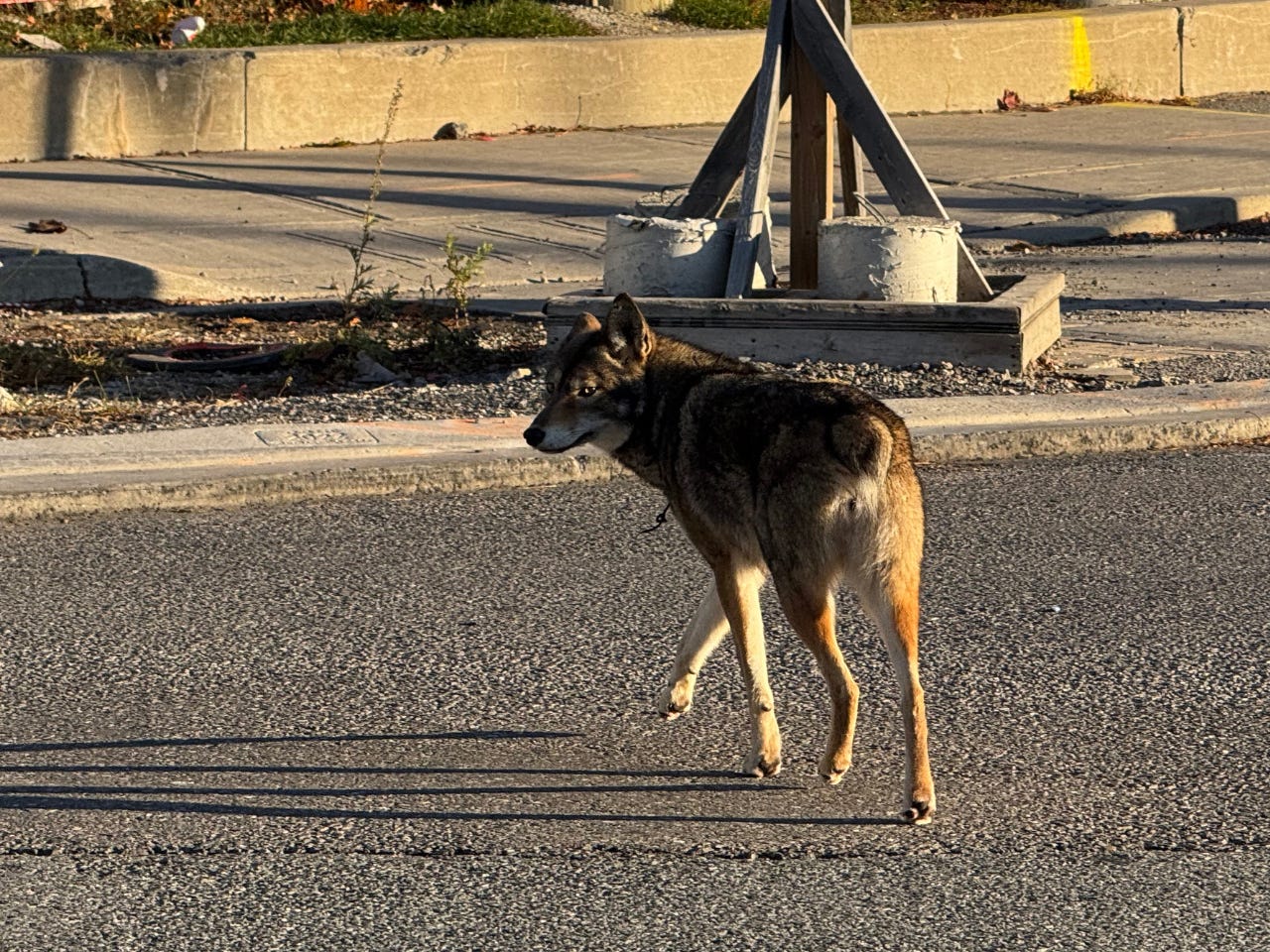
Bunny the Coyote
At the time that I was working with this creative challenge, I became inspired by local news coverage of a charismatic food-conditioned coyote named Bunny living nearby where I live. Listening to the newscast, I even reflected on my newest neighbour: a Red fox living in the backyard. I remembered all of the times I was warned as a child not to feed wild animals.
And yet… people do. When I looked closer, I found the newscast was based on a public service announcement from Bunny herself warning citizens about the dangers that wildlife experience when they regularly find food in places that they should not: dumped food, unsecured garbage, and intentional feeding. When wild animals become food-conditioned their behaviour can become unpredictable. This might be cute for potato-chip-stealing racoons or a little-mouse-in-the-house, but things change when larger animals bein to urbanize.
Bunny the Coyote is nicknamed “Knubz” on account of missing a tail. The nicknames might also describe animals’ bad behaviours, like Romania’s “trash-bin bears.” As more and larger animals move into urban areas in search of food, cities like Osaki, Japan are finding that local hunters are aging or have little experience with large carnivores. People are getting hurt.
And when people get hurt, animals tend to be culled and put-down.
Method
Futures Cone Scenario Development
Scenario generation maintains the necessary level of complexity to support collective idea generation, imagination, and innovation. The Harvard Business Review names scenario-generation as the most recognizable tool in strategic planning (Scoblic, 2020). Scenarios provide a means of trying different, possible futures on for size.
Lately, I have been relying on the Futures Cone as a mental model for envisioning how different futures might take shape. It helps me to visualize how objects on the horizon come into view: as impressionistic silhouettes characterized by their directional movement, general shape, and possible colour.
From Market Insight to Strategic Foresight

Prior market insights developed for the professional services industry revealed trends and change drivers to support this strategic foresight exercise. The professional services industry in Canada is projected to grow, although revenues have eased for management consulting, specialized design, and scientific research and development. Professional servic…
These most recent scenarios were about applying foresight to my personal business planning. Those posts do not go into detail about how the scenarios came to be. My creative challenge was constrained by a 450-wordcount. Now that I have more characters, I can share both my process and practice of foresight. Here are the details for how I arrived at a non-probabilistic scenario and experienced it using a time-machine.
Process
This memo came to me while scanning for signals of change related to urban wildlife management and protection across STEEP-V categories. My analysis included four news sources and three academic journal articles that described trends and reinforcing loops changing the behaviour of coyotes and their predators.
My findings inspired What If? questions and future imaginaries that guided scenario development. What if more coyote sightings continue to increase? What if coyotes attract larger animals? The Futures Cone provided a mental model to understand co-existence with large predatory animals in Canadian cities as outside the probable response of separating humans and animals. It also provided a model for identifying and applying multi-naturalism as a novel philosophical approach to present uncertainties.
Change Drivers
Human-caused climate change is affecting seasonality and the length of the growing season in Northern latitudes thereby reducing natural food sources.
Food insecurity is stemming from the loss of arable land, shorter growing seasons, and humans’ encroachment on animal habitats.
Urbanization is resulting from humans’ and animals’ moving closer to urban centres in search of food.
Trends
Social: People are feeding urban wildlife; larger animals are becoming food conditioned.
Reference Mississauga City Services, 2026; McCurry, 2025; Al Jazeera, 2024Technological: Traditional predator control methods were designed for rural areas (namely, culling) and contemporary wildlife management preferences are influenced by public opinion.
Reference Katju, Marchini, Athreya, and Pasha, 2023Environmental: Urban centres in Canada are experiencing more coyote sightings resulting in novel species interactions. Urban forest patches may reduce human-coyote conflict in cities. Coyotes are more effective in packs, give birth to large litters, and preyed on by lynxes, golden eagles, and cougars in addition to black bears, grizzly bears, and wolves.
Reference Meliane, Prieur, Gehrt, and Ellington, 2026; Gerraty, Carroll, Williams, and Isadore, 2024; and Kingsley, 2024Political: Bunny the Coyote delivered a public service announcement to the municipality where she resides. Japanese municipal authorities declared a state of emergency in response to surges in black bear sightings and maulings and called for wildlife management to become a national policy issue. Romania’s government more than doubled the number of bears park rangers can legally cull through legislation approved in an emergency parliamentary session.
Reference Mississauga City Services, 2026; McCurry, 2025; Al Jazeera, 2024Values: Typical responses to human-wildlife conflict involve the separation of humans and animals. Multinaturalism is a philosophical approach to understanding the social dynamics involved in co-existing with large predators.
Reference McCurry, 2025; Al Jazeera, 2024; Katju, Marchini, Athreya, and Pasha, 2023
Scenario
Time-Machine: A memo from 2041
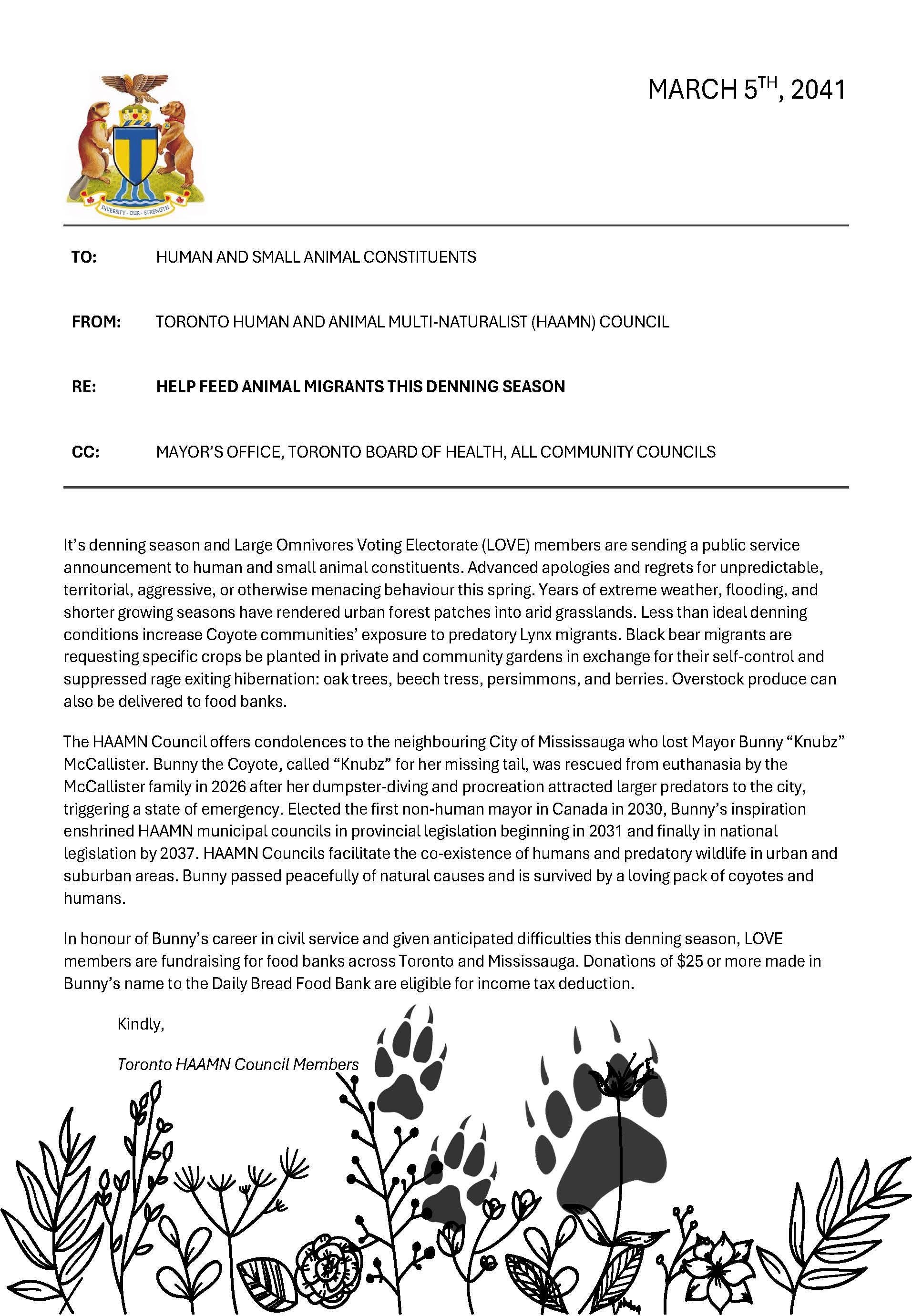
Driven by human-caused climate change, urbanization, and food insecurity, it may become common for large predatory animals to live in Canadian cities by 2041. There is uncertainty around the values that will determine approaches to wildlife management and associated economic impacts. One plausible scenario from this future is illustrated the pictured memo from The City of Toronto’s Human and Animal Multi-Naturalist (HAAMN) Council sent Spring 2041. The memo reads:
“It’s denning season and Large Omnivores Voting Electorate (LOVE) members are sending a public service announcement to human and small animal constituents. Advanced apologies and regrets for unpredictable, territorial, aggressive, or otherwise menacing behaviour this spring. Years of extreme weather, flooding, and shorter growing seasons have rendered urban forest patches into arid grasslands. Less than ideal denning conditions increase Coyote communities’ exposure to predatory Lynx migrants. Black bear migrants are requesting specific crops be planted in private and community gardens in exchange for their self-control and suppressed rage exiting hibernation: oak trees, beech tress, persimmons, and berries. Overstock produce can also be delivered to food banks.
The HAAMN Council offers condolences to the neighbouring City of Mississauga who lost Mayor Bunny “Knubz” McCallister. Bunny the Coyote, called “Knubz” for her missing tail, was rescued from euthanasia by the McCallister family in 2026 after her dumpster-diving and procreation attracted larger predators to the city, triggering a state of emergency. Elected the first non-human mayor in Canada in 2030, Bunny’s inspiration enshrined HAAMN municipal councils in provincial legislation beginning in 2031 and finally in national legislation by 2037. HAAMN Councils facilitate the co-existence of humans and predatory wildlife in urban and suburban areas. Bunny passed peacefully of natural causes and is survived by a loving pack of coyotes and humans.
In honour of Bunny’s career in civil service and given anticipated difficulties this denning season, LOVE members are fundraising for food banks across Toronto and Mississauga. Donations of $25 or more made in Bunny’s name to the Daily Bread Food Bank are eligible for income tax deduction.
Kindly,
Toronto HAAMN Council”
Close
In this scenario, I explored how government might communicate with a more diverse group of constituents in novel ways. I attempt to express a desire to co-exist with urban wildlife while acknowledging risks for humans and animals alike. I also take on a marginalized or deviant perspective: the perspective of those who are typically othered, villainized, and exterminated. This is the perspective of large predatory animals. This scenario is also presented in a humourous way, which also deviates from the typical presentation of scenarios used for emergency management or strategy development.
I had a lot of fun creating and travelling in this time-machine. I hope you do too - please share your thoughts and reactions!
References:
Al Jazeera. (2024, July 16). Romania to cull 500 bears to curb overpopulation after deadly attack. https://aje.io/b266cs
City Services. (2026, March 5). Bunny the Coyote is a warning about feeding wildlife. City of Mississauga.
Gerraty, F. D., Carroll, T., Williams, S., & Isadore, M. (2024). Recovering predators link aquatic and terrestrial ecosystems: River otters subsidize coyotes with carrion. Ecology and evolution, 14(6), e11444. https://doi.org/10.1002/ece3.11444
Kingsley, E. (2024, July 2). Coyote predators: What eats coyotes?. A-Z animals.
McCurry, J. (2025, December 29). Japanese town reeling from year of record bear encounters. The Guardian.
Meliane, M. K., Prieur, A. G. A., Gehrt, S. D., & Ellington, E. H. (2026). Coyote denning behavior in urban environments: an argument for more forests in cities. Urban Forestry & Urban Greening, 129388. https://doi.org/10.1016/j.ufug.2026.129388
Scoblic, J. P. (2020, July 1). Learning from the future. Harvard Business Review.